Footnotes
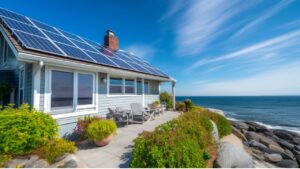
A blog in support of renewable energy.A watchful steward over your Cape Cod home! Your time on Cape Cod is too valuable to worry about home maintenance issues. Eliminate the stress and concerns of managing all the tasks necessary to keep your home functioning in your absence. (Barnstable)
(TM) Che Pecat' is a new and unique line of clothing and accessories that celebrates the best of both Italy and Cape Cod.
Wind, out of the Blue
By Chris Stimpson and Chuck Kleekamp
The excitement on Cape Cod was palpable on the weekend leading up to the MMS hearings on the Cape Wind project, and not just at the thought of dueling minstrels at the microphone. To the unbounded joy of the wind farm opponents on stage, the Deus ex Machina of Blue H USA appeared from the wings with perfect timing to state that you can have wind power without seeing it.
Except that this can't happen for some time, even though Ray Dackerman, Blue H USA general manager has said "It's here now," referring to their technology of a floating wind farm 23 miles south of Martha's Vineyard [1]. And Cape Wind's opponents embraced the idea as an alternative to Cape Wind [2].
Some background is in order. Offshore windfarms support their turbines on fixed hollow towers called monopoles. Total installed cost, including the turbine, is between $2 million and $3million per megawatt, based on European experience with 15 offshore windfarms.
In 2002, Norway's Norsk Hydro Oil & Energy [3] started a pilot project called "Hywind". The concept, to float a 3-megawatt turbine in 400 feet of water tethered with cables to anchors, would cost over $7 million per megawatt.
After six years, the Hywind project has yet to be installed.
"Making floating offshore foundations commercially viable is a significant technological challenge," said Andreas Nauen [4], head of the Siemens PG Wind Power division, the turbine supplier [5] for Hywind. And Bech Gjørv of Norsk Hydro adds: "The goal [of wind farms with 200 turbines] is far in the future, but if we're to succeed in 10-15 years, we have to start the work today." [6].
And so to Blue H, a young Netherlandish company with a patented "tension leg platform" solution, in which anchor chains apply a constant tension to a buoyant, semi-submerged structure to keep the platform level and the turbine tower straight. Last December, 12 miles off the coast of southern Italy in 350 feet of water, the company installed what it termed a "large-scale prototype": an unconventional, 80-kilowatt, fast-spinning 2-bladed turbine delivering zero electrical power [7]. A moment's math tells us that one would need 45 of these to equal the rated output of just one of the 3.6 megawatt turbines planned for Cape Wind.
Martin Reilly, the local Blue H spokesman, claims that "Deep water technology now exists, and it's viable. The cost of generation will be less than any other offshore wind energy generation project proposed to date at this time."[8]. But if Fortune 500 companies like Norsk Hydro and Siemens haven't deployed a single floating prototype in six years and predict a 10-15 year wait for viability, it's quite a stretch to imagine that Blue H could install a 120-turbine, billion-dollar wind farm 45 miles off New Bedford now, qualifying it as an "alternative" to Cape Wind.
And in fact, they can't. In its next round of interim activity the Minerals Management Service (MMS) will evaluate over 40 applications for authorization to erect resource data collection facilities and technology testing only [9]. Offshore wind turbine technology testing will not be authorized through this interim policy, and commercial wind farms will not even be considered [10]. So Blue H has applied to launch their anchored platform supporting a monopole tower topped with dummy weights simulating a wind turbine to test the mooring system [11]. However, MMS may limit the number of authorizations under this policy. Perhaps an MMS permit will go to Blue H, or perhaps to others.
When asked about a likely in-service date for their completed project, Reilly offered a date of 2013 [12]. This suggests a shorter permitting process than Cape Wind, using known technology, has had to endure even to this point. Even Walt Musial, a principal engineer at the National Renewable Energy Laboratory has said: "Blue H appears very serious about this, but it cannot yet be viewed as an alternative to the kind of reliable energy Cape Wind would be able to produce." Regarding floating turbine technology he said: "It hasn't been proven yet. It's very important people's expectations don't get beyond the demonstration project level."[13].
Nonetheless, as a citizens' organization supporting viable renewable energy projects and policies, Clean Power Now has always undertaken to evaluate utility-scale wind power proposals, endorsing those determined viable. So while we welcome Blue H's efforts, we will refrain from endorsing until we have at least seen the company's Expanded Environmental Notice Form and details of its engineering design.
While Blue H is working for the future, we believe it is prudent to follow the European example and build our first offshore wind farm with proven technology, starting in the shallow waters of Nantucket Sound before working in the unknowns of the deep.
Christopher Stimpson,
Board Member, Clean Power Now
Charles W. Kleekamp, P.E. Ret.
Vice President, Clean Power Now
Footnotes:
1. "Floating wind turbines on horizon?" by Karen Jeffrey, Cape Cod Times, March 10, 2008.
2. "Timely Entry for Deep-Water Project," by Mike Seccombe, Vineyard Gazette, March 14, 2008.
3. Norsk Hydro Oil & Energy Company is a Fortune 500 company founded in 1905 with 36,000 employees.
4. "Danish based Siemens Wind Power to supply wind turbine for Hydro project," Invest in Denmark, June 27, 2007.
5. Siemens Power Generation of Germany is a premier international power generation company with 2006 sales of 10 billion Euros and 36,400 employees.
6. Hydro Web Site, Nov. 2, 2005: http://www.hydro.com/en/press_room/news/archive/2005_11/hywind_en.html
7. A telephone conversation by Kleekamp with Ray Dackerman, Blue H USA general manager, on March 20, 2008.
8. Deep-water wind farm plan floated off Vineyard," by Joshua Balling, The Inquirer and Mirror, March 13, 2008
9. Number of applications verified by phone with Ms. Maureen Bornholdt, MMS, on March 28, 2008.
10. This interim policy is listed in the Federal Register, Vol. 72, No. 214, Tuesday, November 6, 2007 p. 62673-62675. Title: "MMS Request for Information and Nominations of Areas for Leases Authorizing Alternative Energy Resource Assessment and Technology Testing Activities."
11. A conversation at the CPN office with Mr. Reilly on March 19, 2008.
12. A conversation at the CPN office with Mr. Reilly on March 19, 2008.
13. "Timely Entry for Deep-Water Project," by Mike Seccombe, Vineyard Gazette, March 14, 2008.
Mid Cape home sales with Amy Surrette Greene and her team of realtors at Martin Surette Realty. A family owned and operated office since 1972. Open seven days a week. (Dennis)
Established in 1984, we are a primary care /walk-in clinic which provides the highest standard of clinical care to our patients plus a warm welcome. Our patients are part of our family. Full lab and x-ray facility on the premises. (Mashpee)
Wind and the Cost of Electricity
Cape Wind's electricity will compete in the market
Oil-generated electricity's cost will continue to increase
The overwhelmingly favorable Mineral Management Service (MMS) draft statement on the Cape Wind project on Nantucket Sound states that the proposed site at Horseshoe Shoal has the lowest estimated cost of energy, equal to 12.2 cents per kilowatt-hour, when compared to all alternative sites [1]. This is in fact less than the NStar rate to you for generated power in February, 2008, which is 12.5 cents per kilowatt-hour, a price that closely reflects the actual price of the wholesale market for the same time period [2].
The latest passion to grip critics of Cape Wind is a misinterpreted MMS statement regarding the profitability of the undertaking. In their propaganda campaign they are saying that Cape Codders will pay double or triple for their power if the wind farm is built [3]. A clarifying statement by the MMS author of the economic considerations, Robert Mense, said: "References to the apparent profitability of development at any of the sites could therefore be misleading, and will not be made in the draft EIS." [4]
Once again it's time to cite the facts, the most obvious of which is that Cape Wind will not be able to sell their power into the wholesale market at an uncompetitive price.
To address this issue one must recall that electrical utilities were deregulated several years ago when they were required to sell off their power plants. The intent being to usher in competition, provide consumer choice, and lower prices.
So now merchant power plants, such as Mirant's Canal station or Dominion's Brayton Point, or even Cape Wind's offshore wind farm, must sell their power into a competitive wholesale market. Sales directly to you, the retail customer are then made by retail distributors like NStar, National Grid or the Cape Light Compact's current supplier (ConEdison Solutions) that offer electricity in a competitive retail market where you, the end user, may choose the lowest cost provider, if that's your basis of decision.
Any merchant plant, including Cape Wind, has two ways to sell into that wholesale market. One is to make a negotiated and often confidential "power purchase agreement (PPA)" with a retail distributor for some or all of its generated power over a fixed period of time. Of course, retail distributors typically want to buy the lowest cost power so they can compete for retail customers like you and me. About three-quarters of all wholesale power in New England is sold through these PPAs.
Alternatively, the merchant plant can offer some, or all, of its generated power to the wholesale hourly spot market administered by the Independent System Operator of the New England grid system (ISO NE). In this case the offer goes into a bid stack arranged from low to high. When the cumulative offers meet the expected load a "clearing price" is established. Those below the clearing price get their power dispatched (injected) into the grid, those above, do not (no sale). This scheme ensures the lowest cost wholesale power is available to the retail distributors, and hence to you.
Of note is the fact that all merchant plants that are dispatched are paid the clearing price regardless of their offer. For example, if a plant offers its power at $35 per megawatt-hour and the clearing price is $65 per megawatt-hour, the plant will be paid $65. And to ensure that renewable power such as wind and hydro is always dispatched ISO rules allow it to be bid into the bottom of the stack with zero fuel cost.
This means the most expensive wholesale offers are bumped off the top of the bid stack thereby lowering the clearing price and ultimately saving you money. Of course the wind and hydro providers will be paid the clearing price for their power, whatever it may be. Also of note is the fact that negotiated PPAs are always dispatched as if bid at zero cost. The prices in these PPAs therefore do not increase the ISO NE clearing prices and in fact can lower it.
All of this means that wind power will compete with conventional sources on a wholesale level and it will always lower the market cost of generated electricity to you, the end customer. Indeed, the savings resulting from this displacement would accrue to electric customers, and are estimated by the Massachusetts Energy Facility Siting Board to be $25 million per year for New England customers [5].
While the price of electricity and its long term stability is important to many, perhaps the most significant consideration regarding the wind farm is the impact on our nation's energy independence and global warming. This first offshore project will replace electricity from fossil fueled power plants avoiding the consumption of some 100 million gallons of oil, equivalent to 20 Bouchard barges like the one that ran aground in Buzzards Bay or 5 LNG tankers like the one disabled off Chatham, all delivering fuel to generate electricity. Likewise it will avoid the emission of about a million tons of carbon dioxide, equivalent to taking 175,000 cars off the road each year [6]. These are the real savings.
Charles W. Kleekamp, P.E. Ret.
Vice President, Clean Power Now
and
Christopher Stimpson,
Board Member, Clean Power Now
Footnotes:
[1] MMS Appendix F: by Robert Mense, p. 17.
[2] NSTAR web site reference as of January, 2008, residential variable rate. As a regulated distribution company, NSTAR purchases electricity from suppliers and passes that power cost directly to customers, with no profit to NSTAR.
[3] "Cape Wind clears environmental hurdle," by Jason Graziadei, Nantucket Inquirer and Mirror, January 17, 2008. Also radio ads.
[4] MMS Response to Peer reviews, pages 11 and 12 of Response in Appendix F.
[5] Massachusetts Energy Facility Siting Board, 2005. Based on "The Cape Wind Project: Impact on New England Electricity Market Prices," February 2002, Analysis by La Capra Associates. "This analysis essentially assumes that natural gas and oil prices will be in line with those forecast in the Energy Information Administration's (EIA) "Annual Energy Outlook 2002" (developed in late 2001). For example, natural gas prices are estimated at approximately $3.4/MMBtu in 2005." It is of note that the natural gas prices are now in the range of $8 to $9/MMBtu therefore the savings from this displacement would now be in the order of $50 to $60 million per year.
[6] Statement of Secretary Ian Bowles, Secretary of Environmental Affairs for the Commonwealth of Massachusetts. March 29, 2007.
Wind, the Beginning of the End of Oil Generated Electricity
Why oil is on the way out for New England's electric grid
But almost 25 percent of our power still comes from it
Abundant wind power, with no fuel cost, is destined to replace the most expensive source of electrical generation - and that is from oil fueled power plants. Allow me to explain. In New England, unlike the rest of the country, oil generated electricity plays a large but diminishing role. Almost a quarter of the installed capacity of all power plants here use oil as fuel [1].
Understanding how electricity is dispatched on the grid is crucial to the explanation. The Independent System Operator called ISO New England, based in Holyoke, is responsible for the reliable operation of the power system by dispatching power plant production and providing a fair wholesale market to sell and buy power.
Dispatch is regulated by a day-ahead hourly bid stack with offers from merchant power plants arranged from lowest bid to highest. The unit of trade is the megawatt-hour (MWh). That's a thousand kilowatt-hours, a unit more familiar to most of us and enough to run a modest home for about two months. As the New England load for each hour is matched with offers, a "clearing price" is established by ISO at the point where the expected load exactly meets that level of offers. All plants offering power below the clearing price are allowed to dispatch (inject) their power onto the grid. Those above, are not. This assures the lowest cost for all consumers. Since power cannot be stored on the grid, the load must be exquisitely balanced with power dispatched at every moment.
What is not perceived by most of the public is the fact that this so called "clearing price" is paid to all providers of power that get dispatched. This means for example, a power plant owner who offers power at $40/MWh for a period when the clearing price becomes $80/MWh, that owner will be paid $80/MWh as will all others whose power is dispatched.
Six years ago the cost of oil and natural gas were roughly equivalent in price per unit of energy, with coal at about half that. Since then, oil and gas have dramatically increased by a factor of roughly four with respect to the price of coal. Knowing the efficiency of generating plants [2] one can calculate the cost of fuel alone to generate electric power. For oil fueled plants it's now at least $93/MWh [3]. For modern natural gas plants, about $48/MWh [4]. And for coal plants, some $18/MWh [5]. It's obvious who's making the most profit as who is being squeezed.
The impact of more costly oil has been to dramatically diminish production from the region's large oil generating plants. For example, the oil-fired Canal Plant in Sandwich (1,120 MW) had a capacity factor (actual production divided by maximum possible production) of 58 percent in the late 1990s consuming some 8 million barrels of oil a year and producing around 6 million MWh. Incidentally, that oil consumption rate is equivalent to almost two days production of all the oil wells in the continental United States for this one power plant in our back yard.
However, last year the Canal plant, the third largest in Massachusetts, was operating at a capacity factor of only about 17 percent producing some 1.7 million MWh [6] by consuming about 2.3 million barrels of oil (96 million gallons). Compared to the expected output of the Cape Wind project of 1.6 million MWh, one wonders if the Canal plant could simply be replaced.
Further north, at the Salem Harbor plant, the fifth largest in the state, where their oil fired Unit #4 (436 MW), which is bigger that all three of its coal units combined, was down to a capacity factor of just 5 percent [7]. And most surprising, the oil fired Unit #4 (446 MW), at Brayton Point, the second largest plant in the state, was down to 1 percent [8]. It is simply turned off most of the year. Currently coal profitably fuels the other three units at both those power plants.
But for wind and hydro plants, the cost of fuel is zero. By ISO rules, these zero-cost fuel generators can bid in at the bottom of the stack; hence are always dispatched [9]. And when they are, they bump off the top the most expensive bids which are almost always from the oil-fueled power plants, and next, from natural gas units [10]. This saves all consumers money by lowering the clearing price of wholesale electricity while providing a competitive return, which is the "clearing price" to wind and hydro plants. Savings for the New England region from the Cape Wind project alone could be some $50 million a year [11].
For a nation addicted to oil, the importance of the impact of utility-scale wind power on national security, energy independence and sustainability cannot be overlooked as it replaces imported oil first and then natural gas. Certainly 20 percent of New England's electricity can be reasonably generated from wind [12]. The avoidance of a million tons of carbon dioxide from oil burners by the Cape Wind project alone, in addition to thousands of tons of unhealthful sulfur and nitrogen oxides, is reason to be optimistic about the future of offshore wind in New England.
As this flagship project leads the way to more offshore projects in Massachusetts and Rhode Island, I believe it will be not only the beginning of the end, but the coup de grâce of base load oil generation.
By the way, the Canal Plant is for sale, along with the rest of Mirant's plants [13].
Charles W. Kleekamp, retired engineer and vice president of Clean Power Now.
[Footnotes]
1. ISO NE Update, Capitol Hill Briefing, Dec. 6, 2006.
2. Efficiency is revealed in a parameter called the heat rate (in BTU/kWh), that is the number of BTUs required to product a kW of electrical power. The heat rate for an oil fueled plant like Canal is 10,164 BTU/kWh, for a coal plant it is about 10,500 BTU/kWh, for a modern combined cycle gas turbine plant it is about 6,700 BTU/kWh.
3. Based on a price of $57.48 for a barrel of 1% sulfur residual fuel oil at New York on 7/31/07. Source: EIA. Note, lower sulfur fuel oil can be about $10 a barrel more. In January 2002, the price was $14.78/barrel.
4. Based on a price of $6.11 for a million BTUs of natural gas at the Henry Hub in Louisiana on July 31, 2007; source, EIA. Add pipeline shipping charge of about $1/million BTU. In January 2002 the price was $2.02/million BTU.
5. Based on a price of $1.78 for a million BTUs of coal for electric plants on April 30, 2007. Source: EIA Table 9.10.
6. Interview at Canal Plant on March 22, 2007.
7. Salem Harbor Station 2005-2006 Emission Report, Jan. 29, 2007.
8. Interview at Brayton Point on March 29, 2007.
9. ISO rule on dispatch of zero cost fuel generators, "Electricity Costs and Pricing in New England's Power Market," February 2006; page 2 of 3.
10. Oil and natural gas set the clearing price 80 percent of all hours; Source: ISO NE, "Ensuring Long Term Reliability of New England's Regional Electricity System," Gordon van Welie, President, March 30, 2006.
11. A savings of $25 million was based on bumping natural gas units with an estimate of natural gas priced at $3.4/mmBTU for 2005. Source: La Capra Associates, Feburary 2002. The price of natural gas as of September 2007 is in the range of $6 to $7/mmBTU, double the price estimate of 2005, hence double the savings.
12. "Offshore Wind Energy Potential for the United States," Walt Musial, National Renewable Energy Laboratory, May 19, 2005. The New England region has an offshore wind resource of 10,300 MW in relatively shallow water up to 30 meters deep. This excludes area inside 5 nautical miles of shore and most of the area for the Rhode Island initiative of 1,150 MW. Source: Table 6-6 of "RIWINDS Phase I: Wind Energy Siting Study," April 2007. Note the current installed capacity New England is 31,000 MW.
13. "Mirant Corp. ponders sale of Sandwich plant," by George Brennan, Cape Cod Times, April 10, 2007.
About Clean Power Now
Clean Power Now is a non-profit volunteer organization that informs citizens and empowers them to support viable renewable energy projects and policies, and to secure their local and regional benefits.
We believe that the timely development of such projects, in conjunction with energy efficiency and conservation, will bring about a clean, healthy environment, an improved economy and a more secure, sustainable America.
Our immediate focus is to increase citizen support of offshore wind power in Nantucket Sound.The Allure of German Wind
But... he doesn't like it in the shallow waters of Nantucket Sound. "[He's] concerned about the project's impact on the environment there," said Mark Forest, Delahunt's spokesman [1]. Pardon us while we mention that after five years and thousands of pages of reports on the environmental impacts of the Cape Wind project it has been determined time and time again that the many positive public benefits far outweigh any negative environmental impact.
So what to do? Delahunt will ask German experts to assess the feasibility of coastal sites in deep water here, reports Sue Reinert in The Patriot Ledger [2]. Albeit the Germans haven't built any offshore windfarms yet. But not to worry. "If we can interest them in Massachusetts... we could be talking not only about the development of a renewable energy site, but also of binging new jobs to this area," Delahunt said [3].
It's as if the German government will donate $65 million [4] to Massachusetts for an experimental deepwater windfarm in Massachusetts as they are at home. Nice try, but really?
The reality of deepwater wind
Experimental? Well... yes. Hopefully our seemingly wind energy embracing Congressman knows that this is the first German offshore project. It's called Borkum West, a joint research program launched by the government and energy utilities Vattenfall, E.ON, EWE AG, and wind-turbine manufacturers REpower and Multibrid. The utilities are adding $165 million to build the small 12-turbine wind farm in water up to 100 feet deep in the Baltic Sea some 35 miles from land [5].
But that's not all... (to mimic the typical TV come-on). The cost of that long landfall cable will be nearly $240 million with another donation of $40 million by the German State [6].
So what's the price of the Borkum experimental windfarm? The total cost is $470 million for this 60 megawatt (MW) project and reveals a unit investment of almost $8 million per MW installed.
The German project is not unlike the Talisman experiment off Scotland in water 150 feet deep at a price of about $6 million/MW installed [7]. It's another government sponsored research project where much of the cost is in individual four-legged lattice type steel foundations that weigh 1,250 tons [8] for each turbine. And the Talisman price tag doesn't include a landfall cable.
Not to throw water on costly research projects, which is always a necessary and commendable step to future progress, but there needs to be a word of prudence. In a cautious statement Talisman Energy has said "current forecasts for electricity prices will never render this Demonstrator Project economic." [9]
Back from the future
Hopefully, while Delahunt is in Europe he will stop in Denmark, Sweden, and England where he could examine fourteen operating shallow water windfarms and another eleven under construction [10]. With 15 years of operational experience with negligible environmental impacts, these economically viable projects are indeed models for the world at large.
Shallow water windfarms in Europe at depths up to 60 feet have established a unit expenditure of about $2.5 million/MW installed [11]. That's about the same as expected for the Cape Wind project. At that level, a reasonable profit can be made without government subsidies for construction. And it's being done now with a maturing mono-pole technology.
It's a long reach to believe that one can jump to deepwater wind at three times the capital cost believing the investment can be significantly reduced through price reductions on tripod or quadra-pile steel towers and costly undersea cable technology [12]. Even the economic tradeoffs of stronger winds far offshore must be balanced with impediments to servicing turbines in higher wave heights that result in a lower availability due to extended down time.
Must we wait?
The question is should we be a victim of procrastination waiting 10 to 20 years for the deployment of economically viable deepwater wind energy systems both here and in Europe?
In the mean time, we can make significant progress to mitigate global warming on a local basis by avoiding a million tons of carbon dioxide emissions from fossil fueled generators by building the Cape Wind project in Nantucket Sound now [13]. As Nathanael Greene, senior policy analyst, Natural Resources Defense Council says, "the Cape Wind project is, to our knowledge, the largest single source of supply side reductions in CO2 currently proposed in the US."
Progress from shallow to gradually deeper alternative sites off New England as listed in both the Army Corps and MMS documents [14] await only proposals and permitting decisions from federal agencies.
Alas, if in 20 years deepwater wind is firmly established as an economically viable source of electricity, the early shallow water projects can be removed. In fact a decommissioning bond is required as part of the federal lease for Cape Wind.
We believe it's essential to begin in Nantucket Sound with current proven technology and evolve to deeper water as the learning curve levels out to where the inevitable price increase of diminishing fossil fuels and their expensive emission controls makes more costly deepwater wind viable.
We do agree with Representative Delahunt that ‘‘Wind is to New England what oil is to Saudi Arabia.'' [15]. However, it would be a tragedy to wait a decade or two for unfounded reasons and the unknown economic advantages of deepwater wind when we can start now.
Barbara Hill
Executive Director, Clean Power Now
Charles Kleekamp, P.E. Ret.
Vice President, Clean Power Now
_____________________________
Footnotes:
1. "Delahunt on wind power mission: In Germany, he'll discuss feasibility of deep-water projects off N.E. coast," by Sue Reinert, The Patriot Ledger, January 23, 2007.
2. Ibid., Ledger
3. "Going deep to renew energy," by Karen Jeffery, Cape Cod Times, January 17, 2007.
4. "Germany eyes offshore wind," UPI, December 1, 2006.
5. Ibid., UPI
6. Ibid., UPI
7. "The Allure of deep-water wind power," by Charles Kleekamp, The Upper Cape Codder, June 1, 2006. Talisman is using the same Repower 5 MW turbines as proposed for 6 of the Borkum turbines.
8. "Beatrice Wind Farm Demonstrator Project Scoping Report," Talisman Energy, Section 3.4 Method of Fixing Substructure to Seabed, p. 10 of 57.
9. Q&A Talisman Energy, http://www.beatricewind.co.uk/
10. List of operating offshore windfarms in Europe. Denmark: Vindeby 1991, Tuno Knob 1995, Middelgrunden 2001, Horns Rev 2002, Nysted 2003, Samsoe 2003. Sweden: Gotland-Bockstigen 1998, Utgrunden 2001, Yttre Stengrund 2001. Ireland: Arklow Bank 2003. United Kingdom: North Hoyle 2003, Scroby Sands 2004, Barrow Offshore 2006, Kentish Flats 2005. List of offshore windfarms under construction now and scheduled during 2007: Sweden: Oresund Lillgrund. Netherlands: Egmond NWS, Windpark Q7-WP. United Kingdom: Inner Dowsing, Lynn Skegness, Gunfleet Sands, Rhyl Flats, Burbo Bank, Teeside, Robin Rigg, Shell Flat
11. "Offshore Wind Energy Potential for the United States," Walt Musial, National Renewable Energy Laboratory, Wind Powering America - Annual State Summit, May 19, 2005, Slide #4: Shallow offshore costs range from 1500€/kW to 2200 €/kW, Horns Rev ~1650€/kW. In U.S. dollars, that's about $1.95 to $2.86 million/MW with Horns Rev at $2.15 million/MW.
12. An example is the Cross Sound Cable between Connecticut and Long Island constructed in 2002 is a high-voltage direct current (HVDC) system. It is 25 miles long and can transmit a maximum power of 330 MW. It cost $150 million.
13. "Findings of the Massachusetts Energy Facility Siting Board," EFSB 02-2, July 2, 2004, p. 168.
14. List of alternate sites just off the Massachusetts coast mentioned are: Tuckernuck Shoal, Handkerchief Shoal, South of Tuckernuck Island, Nantucket Shoals, Monomoy Shoals and East of Nauset Beach.
15. "Going deep to renew energy," by Karen Jeffrey, Cape Cod Times, January 17, 2007.
About Clean Power Now
Clean Power Now is a non-profit grassroots organization that informs citizens and empowers them to support viable renewable energy projects and policies, and to secure their local and regional benefits.
We believe that the timely development of such projects, in conjunction with energy efficiency and conservation, will bring about a clean, healthy environment, an improved economy and a more secure, sustainable America.
Our immediate focus is to increase citizen support of offshore wind power in Nantucket Sound.
FutureGen or Wind?
At Deval Patrick's working group meeting on Cape Cod several individuals spoke passionately about the threat of global warming from fossil fuels. Others expressed optimism for non-polluting sources. So let's examine just two alternatives for our future electrical energy: coal and wind power.
The Hope of "Clean" Coal
Coal gasification, a process that turns coal into synthetic gas, or "syngas" has existed for 50 years. It's a process of combining a coal-water mixture with oxygen and steam to produce a combustible gas which is cleaned by removing sulfur and mercury. Since this process is more expensive than the current cost of natural gas it is heavily subsidized by the federal government [1].
Recent developments to utilize syngas and generate electricity show it is possible but expensive. It is called integrated gasification combined cycle (IGCC) production. In this type of plant an air separation unit isolates the oxygen and nitrogen then the oxygen is used to make syngas. This gas is burned in a modern combined cycle gas turbine plant to generate electricity. Up to 20% of the cost of such plants is subsidized by the government [2]. Only about 10 of these plants have been built world wide with mixed performance results.
FutureGen
The future expectation is that the carbon dioxide (CO2) can be removed and hydrogen produced from the syngas before it is fed to the turbines. The captured CO2 is to be pumped deep underground for storage (hopefully permanently) in suitable geologic formations, a process called "sequestration" producing no emissions (well almost none) other than water.
This is the vision of FutureGen. Through a public-private ownership partnership involving the U.S. Department of Energy (DOE) and an alliance of industrial coal producers and electric utilities as well as state governments and international participants one of these power plants will be built in the United States [3].
The current reality of FutureGen is a plan to build a small 275 megawatt (MW) experimental plant in Texas or Illinois. When completed in 2012 at a cost of about a billion dollars, with a contribution of $700 million from U.S. taxpayers [4], it will sequester a million tons of CO2 produced every year by pumping it into an underground saline formation. The expected operational costs of just capturing the CO2 and sequestration are estimated to be $30 to $100 million every year [5]. It also requires a lease in perpetuity or purchase of underground rights to a radius of 10 miles [6] around the plant (314 square miles). The ultimate cost of the electricity produced has not been accurately forecast, however it is certainly not competitive now.
The Promise of Wind Power
For the sake of comparison there is the reality of building an offshore windfarm in Nantucket Sound now. It's been in the permitting process since 2001. In contrast to a 275 MW FutureGen project, the windfarm will supply a maximum of 454 MW with an average output of 182 MW [7] or 79% of the electrical energy consumed on the Cape & Islands [8]. This wind power will be consumed on the Cape & Islands [9] and will be sold into the market at competitive wholesale rates helping to stabilize the ever increasing cost of electricity with a fuel that is free and abundant.
The cost of building the wind farm is the same as FutureGen, about a billion dollars. On the other hand, the wind farm will be privately financed. No government funds required. And it will avoid the emission of the same million tons of CO2 at no cost to the public [10] as well as avoiding toxic emissions produced from local fossil fueled generating plants.
Cape Wind is the largest single supply-side project in the United States other than FutureGen which will avoid that much global warming gas.
Back to the "Real" Future
Certainly offshore wind will not provide the total electrical energy requirements of New England. But it can provide a significant contribution to the mix for near term needs.
New England's shallow coastal waters (less than 30 meters) with sites that are over five miles from shore are a resource for some 10,000 MW of wind generation capacity [11]. That's equivalent to a third of the present capacity of all the land based power plants in New England [12]. And it's available now. Development awaits only proposals and decisions from permitting agencies.
European offshore wind experience with a dozen operating wind farms beginning in 1991 and burgeoning with eight more under construction this year and next demonstrates shallow-water wind is maturing as a proven technology. Danish environmental organizations carefully monitored their sites for six years and recently reported no adverse effects on birds or sea life [13]. Furthermore, Denmark generates 20% of their electric consumption from wind and integrates it into their grid system with no adverse effects or additional costs.
A Better Way
Offshore wind power technology is available here and now. The tragedy is that there are 140 new but conventional coal-fired plants planned for construction the United States with only a few considering IGCC. The rational is based on the cost of construction and operation [14]. Old is simply cheaper. Most unfortunately, this generation of newly built conventional coal plants will continue spew out some 800 million tons of carbon dioxide every year [15] for the next 50 years [16].
As for "FutureGen [it's] a smokescreen, since it's not intended to bring technology to the market at the pace required to deal with the problem," said Daniel Lashoff, science director at the climate center at the Natural Resources Defense Council. "We don't have that kind of time."
Should we continue to invest in research projects for clean coal? Certainly. Even though more costly, we'll need all domestic options open for the future because oil and natural gas are reaching worldwide peak production limits and becoming increasingly expensive from unstable and unfriendly foreign sources. And the nuclear option has its own problems.
So let's seize the opportunity as Governor Patrick campaigned to become the nation's center for wind power and other renewables development. We need to begin and build the Cape Wind project now! It's not only a better way, it's absolutely essential!
Charles W. Kleekamp, P.E. Ret.
Vice President, Clean Power Now
About Clean Power Now
Clean Power Now is a non-profit volunteer organization that informs citizens and empowers them to support viable renewable energy projects and policies, and to secure their local and regional benefits.
We believe that the timely development of such projects, in conjunction with energy efficiency and conservation, will bring about a clean, healthy environment, an improved economy and a more secure, sustainable America.
Our immediate focus is to increase citizen support of offshore wind power in Nantucket Sound.
Footnotes:
[1] "Renewable Electricity Production Tax Credit Extended and Expanded to Geothermal, Waste Heat and Other Resources," Perkins Coie attorneys, November 19, 2004. The subsidy is $4.37 per ton coal. Note, the current cost of coal for electrical generations is about $24/ton.
[2] Energy Policy Act of 2005, SEC. 1307. CREDIT FOR INVESTMENT IN CLEAN COAL FACILITIES. Sec. 48A. QUALIFYING ADVANCED COAL PROJECT CREDIT, subsection (a) (1) which is 20 percent of the qualified investment for such taxable year in the case of integrated gasification combined cycle projects.
[3] FutureGen Project Update, U.S. Department of Energy, Office of Fossil Energy, May, 2006.
[4] "FutureGen Advances," by Ken Silverstein, Editor-in-Chief, EnergyBiz Insider, April 21, 2006.
[5] "Future of Coal Depends on CO2 Disposal Says Earth Institute Scientist at Senate Conference," Klaus Lackner. A geophysicist with the Earth Institute testified at the U.S. Senate Energy and Natural Resources Committee Coal Conference, March 10, 2005.
[6] The federal Request for Proposal (RFP) also calls for a land area of 10 miles radius or an area encompassing about 100 square miles around the sequestration site for the CO2. (CWK note, a 10 mile radius = 314 square miles). See "Pecos County locations would store byproduct from FutureGen Plant," by Bill Modisett, Odessa American, April 28, 2006.
[7] Cape Wind press release of October 4, 2006 indicates that the new 3.6 MW GE Wind Turbine Model XL, will boost annual production of clean wind energy by 7%. Cape Wind's annual expected wind power production will now be 1,594,207 megawatt hours, up from 1,489,200 megawatt hours. Dividing the MWh by 8,760 hrs/yr gives an average power production of 182 MW.
[8] NStar has said the average power consumption on the Cape & Islands is 230 MW. Thus the ratio of 182/230 is 0.791 or 79% of the power consumed on the Cape & Islands.
[9] Only if more power is generated by the wind farm than is consumed at any point in time on the Cape & Islands will the excess be transported over the canal to the mainland grid.
[10] EFSB 02-2. July 2, 2004. "The Siting Board finds that, in the near term, the operation of the wind farm would reduce regional air emissions by approximately 4,480 tons of SO2, 1,323 tons of NOx and 1,062,554 tons of CO2 annually." p. 168.
[11] "Offshore Wind Energy Potential for the United States," Walt Musial, National Renewable Energy Laboratory, May 19, 2005.
[12] The current New England installed generation capacity is 33,466 MW. ISO NE Morning Report, December 27, 2006.
[13] "Danish Offshore Wind Key Environmental Issues," November 2006, Published by DONG Energy, Vattenfall, The Danish Energy Authority and The Danish Forest and Nature Agency.
[14] "The Energy Challenge," by Simon Romero, New York Times, May 28, 2006
[15] On average, each 1,000 MW coal plant will emit about 5 million tons of CO2 a year, so 140 plants will emit 140 million tons. Incidentally, the 1,100 MW Canal oil fueled plant in Sandwich on Cape Cod, like it coal counterparts emits on average 5 million tons of CO2 a year.
[16] Conventional coal plants (as well as conventional oil-fueled plants) emit about 1,800 pounds (almost a ton) of CO2 per MWh of power produced. Ref. CMR 7.29.
Can We Drill Our Way Out?
Good news from Washington for the oil companies. The U.S. senate just passed a narrowly focused bill that will open 8.3 million acres for new energy development in the Gulf of Mexico [1]. A hundred miles off the coast of Florida, encroaching on a moratoria region, it is called “Sale 181 Area,” and may contain as much as 1.2 billion barrels of oil [2]. The house has its own version that is even more ambitious. It would expand the drilling to most of the continental shelf off the Atlantic and Pacific coasts [3]. And yes, this means off New England.
The senate majority leader Bill Frist rammed this bill through the senate during the remaining time for legislation this year without any amendments. Hyped to “Enhance the energy independence and security of the United States,” the hurried plunge will be sold to the public as an answer to our problems. And some people will believe it.
It seems this administration’s attitude is to convince the people of the U.S. that we can appease our oil gluttony if we just focus on drilling in the last reservoirs of oil under our control. This blind charge doomed any discussion in the senate of sensible provisions to address our addiction to oil, only a misguided attempt to feed it.
As dictated by Bill Frist, there were no amendments offered for stringent fuel efficiency standards for cars that really could drastically reduce imports. Try 40 mpg average rather than the current 21 mpg. That would save the import of some 4 million barrels a day from you know whom.
Unfortunately there was no discussion of repealing the total royalty relief programs for energy companies that are currently taking our oil for free. Traditionally, this royalty is one-sixth or 16% based on the selling price of oil. That relief was intended to encourage expensive deep drilling in our dwindling Gulf reserves. In truth it is a government giveaway of $7 billion dollars over the next five years to energy developers of royalties that belong to you and me [4]. And who’s making record profits? In this last quarter alone the windfall goes to: Exxon Mobil - $10 billion, ConocoPhillips - $5 billion, and BP - $7 billion. We pay for it at the gas pump. That’s simply outrageous.
And far beyond the imagination of most senators, much less for discussion, is the development of renewable energy for long-term sustainability. They could have at least extend the modest production tax credit for wind energy that ends next year. But no. Not in this bill. Better to drill for the dwindling reserves, feed the profits, and get elected again.
A billion barrels sounds like a lot of oil. But consider the reality in relation to our import of 11 million barrels a day [5]. Just suppose this new Gulf area could magically be brought online at a rate equal to these foreign imports. The production would last just about 110 days! We certainly are addicted to oil! Or more plausibly, if pumped at a rate of just one million barrels a day it would last for about three-and-a-half years. So what’s next? I’m concerned about an inconvenient conclusion.
Remember Denmark? In 1973 they generated 90% of their electricity from imported oil. Never again. Now not only are they energy self sufficient, but they export 50% of their oil, 30% of their natural gas and 19% of their electrical energy [6].
And remember wind energy? The wind is free and plentiful and not subject to cutoff. Denmark is the world’s leader in the generation of wind energy and also in the manufacturing and technology of wind turbines. By the way, where do you think the five big wind turbines in Massachusetts were made? You guessed it. Denmark [7].
So here we sit under the shadow of unhealthful emissions from the Canal power plant that consumes about 8 million barrels of oil a year. That’s almost two days production from all the oil wells in the continental United States [8]. And our Senator Kennedy and Representative Delahunt are doing all they can to kill the country’s first offshore windfarm on Nantucket Sound that could potentially replace 2 million barrels of that imported oil to generate pollution-free electricity with GE wind turbines and no global warming impact.
Unfortunately many members of congress feel compelled to drain the last of Mother Earth’s oil in a fleeting gluttonous feast of fun in big cars and energy company record profits to ensure their election for another term. With little view of the future and the impact of global warming they will quickly burn through our remaining resources that should be saved and stringently parceled out by future generations. It remains to be seen what the compromise bill will look like after the summer recess is over. But the oil companies will undoubtedly be delighted.
So, do you still think we can drill our way out? Think again. I just ordered my Prius.
Chuck Kleekamp, P.E. Ret.
Vice President, Clean Power Now
Footnotes:
1. “Senate Passage of Energy Bill Appears Assured,” by Michael Janofsky, New York Times, July 27, 2006. This is Senate Bill S. 3711 introduced on July 21, 2006.
2. Map of 181 Area identified as map 15, page 58, of the Proposed Final Outer Continental Shelf Oil and Gas Leasing Program for 1997-2002 of the Minerals Management Service.
3. Senate Bill Lifts Hopes of Big Oil Offshore,” by Clifford Krauss, New York Times, August 3, 2006.
4. U.S. Has Royalty Plan to Give Windfall to Oil Companies,” by Edmund Andrews, New York Times, February 14, 2006.
5. EIA This Week in Petroleum (Crude Oil), http://tonto.eia.doe.gov/oog/info/twip/twip_crude.html
6. Energy in Denmark 2003,” Danish Energy Authority, p. 9
7. The five large wind turbines in Massachusetts are manufactured by Vestas in Denmark and they are: Hull One - 660 kW, Hull Two - 1.8 MW; Massachusetts Maritime Academy – 660 kW; Orleans (to be delivered soon) two 1.5 MW units.
8. EIA This Week in Petroleum (Crude Oil):
http://tonto.eia.doe.gov/oog/info/twip/twip_crude.htmlDaily US production in 2005 was 5.120 Mbbls/day, subtracting Alaska: 0.801 Mbbls/day = 4.319 Mbbls/day.
Heat Wave - Watch ISO NE Today & Tomorrow
The price rises with the temperature
You may be interested in tracking the electrical load on the New England grid today and tomorrow. It’s easy. Just go the website: iso-ne.com and look at the LMP Price Ticker on the right.
Windsmart will love this. Squeeze the size of the page and put it in a corner of your screen so you can glance at it anytime. How about a pool to guess the maximum price and load today?
Note, this ticker wholesale price is in dollars per megawatt-hour (MWh). To convert to our usual way of thinking, that is, in terms of cents per kilowatt-hour (kWh), simply divide by 10. Thus, (86.67 is the same as 8.667 cents per kWh. That was the price at 9:25 AM today with a load of 22,156 megawatts.
The ticker also shows the instantaneous New England Load in megawatts (MW). Note the installed generating capacity is 30,617 MW.
This ticker rolls through all the zones (Z) in New England and is updated every 5 minutes. It also shows the tie lines to New England from surrounding areas outside our boundary.
A note of explanation. LMP stands for Locational Marginal Pricing. It varies from state-to-state depending on how much generating capacity is on line in that state, (the “Energy Component”), how much a cost is associated with the capacity of transmission lines connected to that state (the “Congestion Component”), and the “Loss Component” that is the loss in the transmission lines due to their internal electrical resistance.
The zones were originally just the states themselves. Now however, Massachusetts is divided into three zones: West and Central Mass, (WCMASS); Southeast Mass, that’s us (SEMASS); and Northeast Mass including Boston (NEMASSBOST).
The high voltage tie lines that allow power under contract to flow in and out of New England:
- The Cross Sound Cable (Long Island Sound, 330 MW, usually sending power to Long Island)
- Highgate
- New Brunswick (usually bringing power in from New Brunswick)
- New York AC (the state of New York, AC? Its not air conditioning)
- Phase I/II
- Internal Hub
As the load approaches the maximum installed capacity along with the capacity of the tie lines, the price goes up dramatically. That’s when expensive peaker plants come online. The last really big summer load on the grid was August 14, 2002 with a Boston temperature of 101 degrees. The price went from a low at 5 AM of $26.86/MWh to a max of $1,000.00/MWh during 3 to 5 PM.
Today, the weatherman says it will be 95° in Boston, tomorrow, 100°
If you would like to read more about ISO NE refer to my Footnotes Blog of 05/11/06, titled: “Understanding ISO New England and Wind.”
In addition, if you’re really into it, click on the ISO “Morning Report” under “At a Glance”, upper right corner. Lots of interesting stuff... but perhaps a longer explanation.
The Allure of Deepwater Wind Power
European experience with offshore wind farms in relatively shallow costal waters is a maturing technology. With a dozen operational windfarms built over the last 12 years in waters up to 60 feet deep and with 20 or more in the construction and permitting stage their economic, environmental and safety issues have been largely addressed. These shallow water windfarms make use of well developed simple monopole foundations driven deep into the seabed or, so called “gravity bases”, concrete structures much like a flat bottom Christmas tree stand that are floated in place, submersed and filled with rock.
Certainly far offshore winds in deep water are more plentiful and stronger than those nearer the coast. And the lure of such development is understandable from the potential of enormous wind energy production. However technical viability and economic practicality lay somewhere in the future. The question is how far in the future? And what must be done to get there? And must we wait?
Future deepwater windfarms in over 60 feet of water or so will require much more expensive multi-leg structures or floating platforms for depths up to several hundred feet. This technology is being explored by energy companies with experience in offshore oil and gas platforms. Currently such construction is possible but its economic viability and operational performance is far from reality.
For example, the first deepwater demonstration project now in the permitting stage is undertaken by Talisman Energy, an oil and gas producer in the North Sea. It will consist of two newly designed five-megawatt (MW) wind turbines 14 miles off the Scottish coast in 150 feet of water. Perched on top of four-legged undersea lattice-type foundation structures, the two wind turbines will provide power to nearby oil and gas platforms in their Beatrice complex. The total cost of this project is $58 million dollars provided by Talisman, Scottish and Southern Energy (UK), and three government agencies [1]. This cost does not include the expensive high-voltage undersea cables that would be required to bring wind power ashore. Talisman will collect performance data, look for ways to reduce costs and develop operating procedures over five years to examine the feasibility and benefits of creating a future commercial deepwater wind farm at this site [2].
Compared to conventional shallow water offshore windfarms that cost about $2 million per MW installed [3], the fixed-pile foundation Talisman project at $5.8 million per MW is almost three times as expensive and prohibitively uneconomical in the near term.
In a cautious statement Talisman Energy has said “current forecasts for electricity prices will never render this Demonstrator Project economic. It is an R&D project, not a commercial one, and as such requires public sector funding in order to proceed.” Furthermore, they say it is impossible, at this stage to give any definitive answer regarding the go ahead for the commercialization of this project “but it certainly should not be regarded as inevitable.” [4]
For even deeper water installations from 600 to 2,000 feet, anchored floating platforms are envisioned. The first experiment with this type of foundation is under development at Hydro Oil & Energy in Norway [5]. In this project a single 3MW wind turbine will be mounted to an undersea floating concrete foundation that’s anchored to the sea floor 400 feet below the surface of the ocean. The hub of the turbine monopole will be 260 feet above the surface of the sea. For the concept to work, it is crucial that the wind turbines be light, requiring further technological development.
This floating wind turbine demonstration project will require about $23 million to complete [6]. The comparative unit cost is about $7.7 million per MW installed. Hydro’s future goal for large offshore floating windfarms is far in the future, “but if we’re to succeed in 10 to 15 years, we have to start the work today,” said Alexandra Bech Gjørv, Hydro’s director of new energy forms.
General Electric, in addition to manufacturing the 3.6 MW turbines slated for the Cape Wind project, has embarked on a multi-year research effort to design a 7 MW far offshore unit. The U.S. Department of Energy has signed a $27 million contract with GE for this development. The advanced wind system concepts will include innovative foundations, construction techniques, rotor designs and electrical components designed for use in the ocean’s harsh environment [7].
So the question remains. How far in the future will these research and development projects become realistically competitive with shallow water projects? History is replete with promising technologies that have taken decades to commercialize. For example the evolution of the transistor to large scale integrated circuits of today has taken 50 years. Photovoltaic cells have existed since the early 1900s and have yet to evolve into competitive large scale energy sources.
It is simply conjecture to answer the question of “how long?” for deep water wind. “The biggest challenge for deepwater wind turbines will be to merge the mature but expensive technologies borne of the oil and gas industry with the experience and low-cost economic drivers fueling the shallow water offshore wind energy industry,” said Walt Musial of the National Renewable Energy Laboratory [8]. He speculated that “commercial deepwater technology is 10-15 years away.” [9] And Greg Watson, Vice President of the Massachusetts Technology Collaborative adds: “A number of issues need to be addressed before economically viable electricity-generating wind facilities can be erected in the deep waters off the US. Our experts are confident they can be addressed, but not overnight, and not without the benefit of experience gained from shallow water projects.” [10]
All evidence makes it clear that we cannot afford to wait to avoid catastrophic consequences. How much time do we have? The mounting crisis of energy prices, national security and global warming can be eased in part with the development of shallow water wind farms. Let’s embrace the Cape Wind project, the flagship of our country’s first offshore windfarm. Let’s get started now and make it work.
Charles W. Kleekamp, P.E. Ret.
Vice President, Clean Power Now
Footnotes:
1. “Wind Farm Demonstration Project Launched,” 2004 Talisman Corporate Responsibility Report. The project will receive $7 million from each of the Scottish Executive and the UK Department of Trade and Industry and $10 million from the European Commission. Talisman and their co-venturer in this project will each contribute over $17 million.
2. Talisman reference in: http://www.talisman-energy.com/cr_online
3. “Offshore Wind Energy Potential for the United States,” Walt Musial, National Renewable Energy Laboratory, Wind Powering America - Annual State Summit, May 19, 2005, Slide #4: Shallow offshore costs range from 2200 €/kW to 1500€/kW, Horns Rev ~1650€/kW.
4. Q&A Talisman Energy, http://www.beatricewind.co.uk
5. Hydro (the organization) is an energy and aluminum supplier founded in 1905, with 36,000 employees in nearly 40 countries. They are a leading offshore producer of oil and gas, the world's third-largest integrated aluminum supplier and a pioneer in renewable energy and energy-efficient solutions.
6. “Norway’s Hydro Develops Floating Wind Turbines,” by Michael Richard, Treehugger, 11/6/05
7. “DOE, General Electric To Develop U.S. Offshore Wind Turbine,” Clean Edge News, March 17, 2006.
8. “Future for Offshore Wind Energy in the United States,” W. Musial, S. Butterfield, National Renewable Energy Laboratory, Energy Ocean Conference, Palm Beach, Florida, June 28-29, 2004.
9. “Offshore Wind Energy Potential for the United States,” Walt Musial, National Renewable Energy Laboratory, Wind Powering America – Annual State Summit, May 19, 2005, summary slide 23.
10. “Catching the Sea Breeze,” Commentary by Greg Watson, Boston Globe, January 11, 2006.
About Clean Power Now
Clean Power Now is a non-profit volunteer organization that informs citizens and empowers them to support viable renewable energy projects and policies, and to secure their local and regional benefits.
We believe that the timely development of such projects, in conjunction with energy efficiency and conservation, will bring about a clean, healthy environment, an improved economy and a more secure, sustainable America.
Our immediate focus is to increase citizen support of offshore wind power in Nantucket Sound.
Cape Wind, Rules, and Fairness
A comment has been made that no rules were in place when Cape Wind started is simply in error. Cape Wind has abided by all the rules in place since applying for a permit at least since November 15, 2001 when they submitted the “Expanded Environmental Notification Form” to the Executive Office of Environmental Affairs in Boston. That 200 page document and all the environmental assessments contained therein was undoubtedly very costly.
Since then an exhaustive list of rules were followed with 20 or more public agencies culminating with the permit application to the Army Corps of Engineers and their Draft Environmental Impact Statement of some 4,000 pages on November 8, 2004. By that time, some 20 million dollars was expended by Cape Wind in “following the rules” that were all in place at that time.
Since then the rules have changed, the Mineral Management Service (MMS) has taken over and more millions of dollars will be spent by Cape Wind by their willingness to comply with the changed rules in implementing a revised impact statement by the MMS that will be completed over the next two years or so.
Not to be lost in the detail... but indeed Cape Wind will pay a lease for a “shared” use of the federal property (it’s not state property) as required in the Energy Policy Act of 2005 (EPACT) just enacted last August. The Secretary of the Interior will certainly impose a reasonable lease (with 27% going to the State) for the shared use of the Sound (even though it extracts nothing other than electricity generated by the free wind).
And yes, competitive bids for offshore leases will be required for future wind farms in federal waters with the exception, in fairness, to the two windfarms that were in the permitting stages before the EPACT was enacted, namely Cape Wind on Nantucket Sound and the Long Island Power Authority’s windfarm off Long Island.
In response to the fairness issue let me add that the staff at the Senate Energy Committee said it best in a prepared a three-page document, entitled, “Cape Wind Termination Provision (Section 414) in the Coast Guard Authorization Conference Report”, and I quote(emphasis added):
“…Consistency and fairness also dictated a commitment to a smooth transition from the previous regulatory system into the more comprehensive one under EPACT 2005. That necessitated some transition provisions for the few existing projects that had started prior to the enactment of EPACT. The most notable of these was the Cape Wind project. It had particularly made progress towards Federal permitting prior to enactment of EPACT. The Cape Wind developers had permitted, successfully defended in Federal court, constructed, and operated an offshore test facility to qualify the wind resource at the proposed site, at considerable private expense.“Because of the substantial financial investment made by Cape Wind under the previous regulatory system, which did not require competitive bidding prior to initiating project specific regulatory compliance activities (which are quite costly), the Cape Wind project and other projects that could demonstrate the same characteristics (either through construction of offshore test facilities or through responses to requests for proposals by a public authority) were exempted from the competition requirements that apply to de novo offshore wind development after the date of enactment of EPACT. In addition to being an equitable outcome for projects that had fully complied with the previously existing Federal rules on the OCS, this also prevented the considerable prior public investment by Federal and State governments in analysis and permitting of offshore wind development from being thrown away arbitrarily.
“If approved, the Cape Wind project will pay the same royalties to the Federal government that MMS will charge to all other offshore wind projects.” “The charge that the provisions of section 388 of EPACT 2005 represent some special giveaway to the Cape Wind project or any other existing offshore energy project is without foundation.”End of staff at the Senate Energy Committee quotation.
Regards,
Chuck Kleekamp, P.E. Ret.
Vice President, Clean Power Now
A Vote to far?
A few commentators have brought up the interesting question of putting the Nantucket wind farm permit up to a vote of “local” people to whom the water belongs.
An interesting and debatable concept, but one that most likely leads to a conclusion unsatisfactory to many. Rarely do I offer personal opinions since I like to be informed and debate on factual substantiated information. In this question I don’t believe there is an easy or correct answer to the debate. So my opinion only is offered. And indeed, everyone is entitled to an opinion. Yours are as valid as mine.
In our treasured town meeting, a true legacy of democracy, we are called on as residents to propose, discuss, and vote on all kinds of items from budgets to changes in zoning bylaws. Usually a majority rules. In some cases a two-thirds majority is required. None-the-less, every registered voter in town is welcome to his or her own opinion on just how to vote on these local issues. Hopefully, they are fully informed of the complexities of the issues.
The idea expands to the state level. Instead of voting on all budgets and all bills introduced, we elect our representatives to do that. Yes, there are some exceptions, like binding referendums on which we all can cast a deciding vote.
And not to bore, but on to the national level... likewise says it all. Well almost. Except for the most astounding fact that we don’t have a majority vote for the president. Some special group identified by our founding fathers called the “Electoral College” does that task. (As a young person, I always wondered where that college was located. Well, we all know how well that serves a true democracy. By the way, do the Iraqies have an Electoral College now?
Back to the point. A vote on the windfarm?
Well, just who “owns” that water sheet and the mineral and fishing rights within and below it? How do you get to be a resident and a registered voter on Nantucket Sound?
It seems to me that the waters within the three mile limit belong to the people of Massachusetts. You want to do something there?... better know and abide by the state regulations. If indeed there were to be a vote, for example, on a permit for the windfarms proposed in Buzzards Bay (state waters), indeed all the residents of Massachusetts (who own it) ought to be able to vote on it. Note, since 81% of state residents support the windfarm on Nantucket sound, I presume that those same state residents would likely support the windfarms in the state waters of Buzzards Bay and would vote in the affirmative. Or would you argue that just the local folks who own contiguous ocean property on that Bay be able to vote on it?
And waters beyond the three mile limit? They clearly belong to all the people of the United States (except in Texas – I believe it’s 14 miles there). Then it follows then that all the residents of the United States should be allowed to vote on each offshore windfarm in federal waters. What do you think the result of that vote would be?
I think most informed people realize that efficiency alone, as important and well intentioned as it is, is simply not halting the national need for more electrical power. And these informed citizens would carefully consider their options and choices before casting a vote.
So what are the choices? Limit the size of the population? Build no new homes or businesses? Allow no one (including businesses) to increase their use of electricity over their 2006 level? Penalties for that? Build more coal or nuclear plants? Where? A vote on that too? Let’s put one or two in Boston, that’s where the big load is. Or maybe put a small nuclear plant on Nantucket Island, they wouldn’t have to put another cable under that pristine sound. How about building more oil or natural gas fueled generating plants? Like the new prices? No worry for the next generation’s need for oil and gas... or will it last forever? And you like sending our wealth to those foreign suppliers of oil and gas that are so sympathetic to our needs? (We have reached peak oil and natural gas production in the United States in 1973... downhill ever since). And you like the health effects from polluting fossil plants? Need I remind you Cape Cod has the worst air quality in the Commonwealth? (And the pollution’s not all from the Midwest... did you notice that smoke stack when you came across the Sagamore Bridge... what do you think is coming out of it? And the CO2 addition to global warming? And on ... bored yet? Or did your insurance policy just go up (or canceled) on your water-view home?
So now what is your vote? Like wind? Sure! But put it somewhere else please...? hey, Buzzards Bay is fine... right? And where to put the next one after that, and the next...? Well, just not where you’ll see it? Is that social justice? Let someone else vote on it for their view.
Well my choice is very clear... we must begin now with renewables, and the most benign viable utility scale renewable is wind power. It could easily contribute 20% to the national need.
I vote for the starting in Massachusetts with the offshore windfarm on Nantucket Sound. That Sound belongs to me... as well as to you... and indeed to every American. So let’s have a national vote!
Regards,
Chuck Kleekamp
About This Blog

Chuck Kleekamp, P.E. Ret., is a director of Clean Power Now and frequently comments on renewable energy and the proposed wind farm on Nantucket Sound.
Recent Comments
- To Monponsett , hello , it was a criminal act
16 mins ago - To capemom , "quadrangular " is portugueise word for "FOURSQUARE"
30 mins ago - What are gas prices on the Cape? The news said
1 hr, 5 mins ago - Thanks, Producer! And our multi-media page is WAY better than
1 hr, 25 mins ago - I heard the house in Harwich was once the summer
2 hrs, 22 mins ago
CCT Blog List
- Newest Blog Posts
- Newest Comments
- Op-Ed
- Cape & Islands News
- EXTRA...
- One Day at a Time
- Cape Cod History
- Trail Hound
- The Blogfather
- The Great Gadfly
- Robbins Report
- State of Cape Cod
- Solon Economou
- Cape Wide News
- Ray Gottwald's Blog
- Myrbie & Dax
- Cape Cod Crusader
- The Savvy Thrifter
- Mahler's Music Notes
- Entering Falmouth
- MacMillan Wharf
- Cape Cod Maritime Museum
- Ned Sonntag
- The Opinionator
- Bismore Park
- Media Watch
- Buckley's Blog
- Cape Cod Rock Hopper
- Politicalendar
- Entering Bourne
- Historic Harwich
- Brewster Readathon!
- Bogtrotter
- Massachusetts Democrant
- The Natural
- East of Boston
- Cape Politics
- Cheap Gas
- Conservative's Conscience
- Letters to the Editor
- Aaron Maloy's Blog
- Theatre
- Art vs. Life
- Brewster Rec
- Off the Shelf
- Tours of Cape Cod Video Contest
- Boston Bureau
- Over the Bridge
- Bree's Blog
- CasinoWatch
- Cheap Eats
- Anastasia's Blog
- Cape Cod Kidz
- Goose News
- Barnstable County Report
- Journo
- Seufert's Scenes
- Editorial
- Footnotes
- Samizdat
- Sea Street
- Barnstable County Bill
- Renewable Energy Revolution
- Wavemaker
- Fish Out of Water
- Travel Tales
- Cape 20 Something
- Save ourselves
- Toward Democracy
- Building Bridges
Archives
- April 2008 (1)
- March 2008 (1)
- September 2007 (1)
- February 2007 (1)
- January 2007 (1)
- August 2006 (2)
- July 2006 (1)
- June 2006 (3)
- May 2006 (1)
- April 2006 (1)
- December 2005 (1)
Become a CapeCodToday Blogger!
Are you passionate about your community? Do you blog or at least harbor thoughts of doing so?
If so, CapeCodToday.com would like to host your blog on our CapeCodToday weblog publishing platform.